Computer-generated holography is a technology valuable for efficient projection and
three-dimensional displays, with a growing number of calculation algorithms and relatively
simple optical setups for image reconstruction. Among available technologies, liquid
crystal on silicon spatial light modulators can provide uncomplicated phase modulation
of incident wavefronts. However, these devices face challenges to overcome, such as the
presence of multiple image duplicates in hologram reconstructions. Here, we propose a
method for reducing visibility of those duplicates in which the volume and complexity of
the setup remain the same. It is based on randomisation of positions of light-modulating
pixels and distorting the otherwise regular pixel array of the modulator, without modifying
the device. We present a theoretical analysis and results obtained in both simulations and
experiment. Signal-to-noise ratio in the areas surrounding the desired image is shown to
decrease, suppressing the presence of image duplicates. Various levels of randomisation
are considered and can be selected with specific applications in mind.
Introduction
Holography – the art of recording the information about
both intensity and phase of the wavefront, as well as its
reconstruction – has been present in scientific studies since
1948 when Gabor introduced the idea [1]. Since then, the development
of technology enabled various applications of this
phenomenon, from static, analogue and digital holography
for medicine, 3D imaging, holographic TV and compressive
holographic tomography [2–4], to computer-generated holography
for beam conversion, 3D displays [5–7] and dynamic
holographic projection [8]. However, despite the many benefits
of this technology and the progressing miniaturisation
of setups, some challenges remain. The most widely used
devices for displaying numerically calculated holograms,
called spatial light modulators (SLMs), are digital micromirror
devices (DMDs) applicable for amplitude holograms
and liquid crystal on silicon (LCoS) SLMs that offer phase
modulation of grey-scale values. In LCoS SLMs, which
are the focus of our research, the fixed pixel array causes
the presence of wavefront duplicates in the reconstructed far
field [9]. Those duplicates can be removed, for example, by
employing 4f systems for spatial filtering [10, 11], which,
however, leads to an increased volume of more complex
projection setups and hinders miniaturisation. It is a known
challenge in holography and has been addressed in Fresnel
holography by altering algorithms that calculate phase patterns
[12], or in near-field point-formed holograms by adding
a diffusive element [13]. In dynamic Fourier holography,
this effect is just as important to address [14, 15]. However,
the state-of-the-art does not offer an efficient, low-volume
solution for this type of holography. One of the considered
approaches is focused on devices of different builds, which
can limit the visibility of ghost images. For example, Smalley
et al. presented a leaky-mode approach [16]; other previously
published works introduce a new ultrafast material
for holographic recording [17, 18]. However, such devices
are often difficult to control or exhibit a highly decreased
efficiency, which is why a solution for easy-to-use LCoS
SLMs would be favourable.
The problem of limiting the number of visible diffraction
orders can also be encountered in other fields of diffractive
optics, i.e., diffraction gratings, with various proposed solutions.
Simple amplitude sinusoidal gratings are efficient in
limiting diffraction orders to only three central diffraction
orders [19], however, smooth sinusoidal gratings are not possible
to display on LCoS SLMs and more complex solutions
need to be considered [20].
Research on structures with disrupted regularity of their
patterns has been reported to reduce the number of visible
duplicates, e.g., for zig-zag gratings [21], grooves of
randomised positions [22, 23], or even and odd rows of
elementary cells shifted in relation to each other [24]. For
computer-generated phase-only holograms, which are 2D
distributions of phase shift values, the most relevant findings
seem to refer to the randomized positioning of each elementary
cell of a 2D grating [25], as researched by Wei et al. [9],
who investigated its application for static diffractive structures.
When a random shift was applied to the pixels of a
manufactured structure, the visibility of duplicated images
was reduced at the cost of increased noise.
In our work, we discuss a randomisation method for
reducing the visibility of image duplicates that can be applied
specifically for LCoS SLMs of static, periodic pixel patterns.
In this process, the formation of the replicas of images is
suppressed and the intensity in the area surrounding the
main target image is redirected into static noise instead. We
introduce a theoretical analysis of the method, compare
different levels of randomisation, and present experimental
results.
Theoretical discussion and simulations
LCoS SLMs consist of fixed arrays of electrodes. As such,
it is not possible to simply change the pixels positions to
introduce randomisation. Afuture usage could use a subpixel
mask, covering the edges of each pixel in an adjustable way,
without sacrificing the bandwidth of the SLM. However, for
some chosen applications, as well as in general proof of
concept, randomisation can be introduced to these devices
by undersampling, as follows: A phase hologram can be
resized, e.g., stretched four times in both directions, so that
each phase value corresponds to 4 × 4 pixels. We can then
divide an SLM into such 4 × 4 px subsections and randomly
choose only one pixel within its area, which will display the
phase-shift value defined by the stretched hologram.
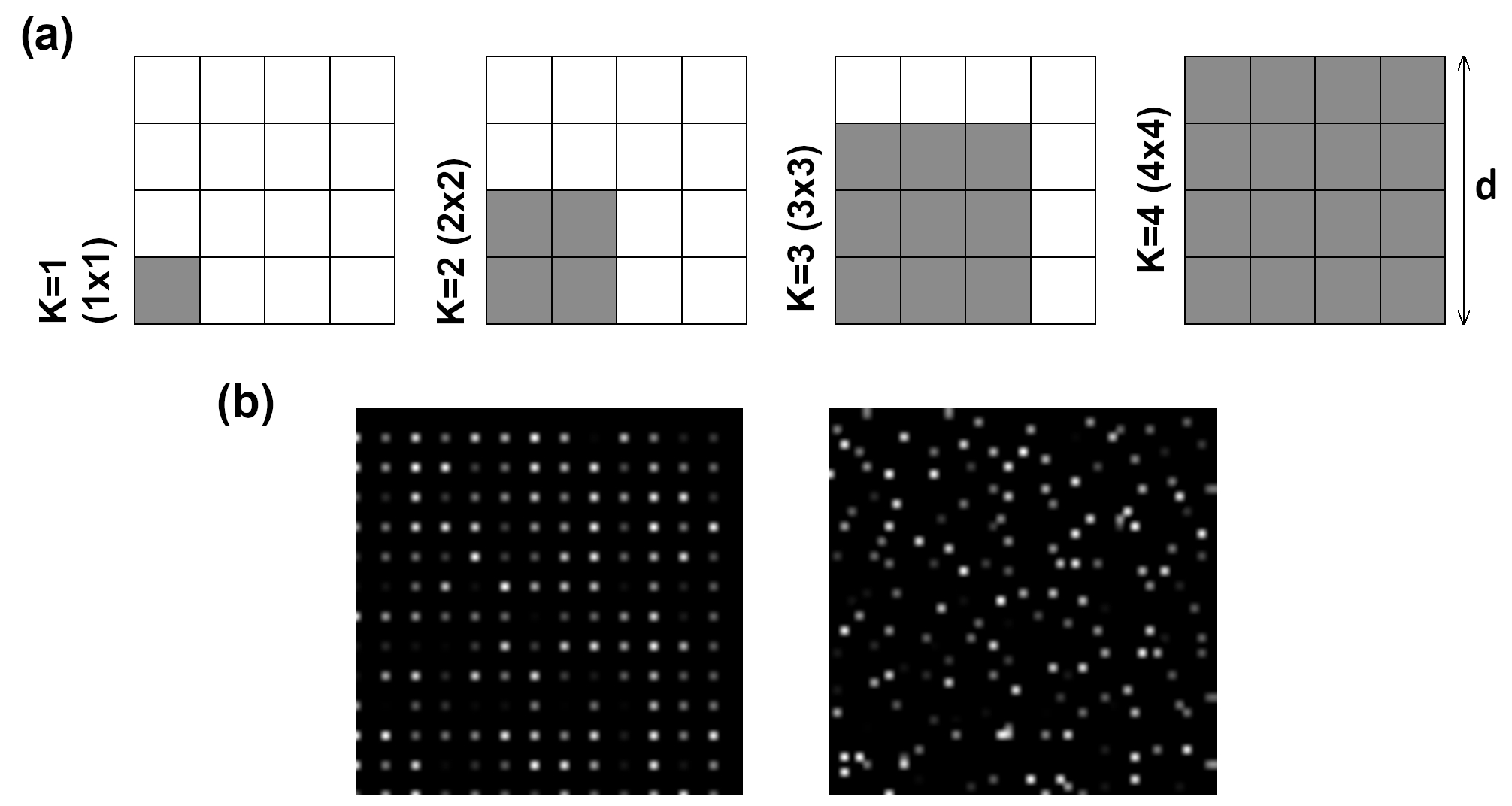
In such an SLM subsection, four possible randomisation
levels can be considered, as shown in Fig. 1(a): none,
low, medium, and high. A visual example of a resulting
randomised hologram can be seen in Fig. 1(b).
Fig. 1.Pixel positions with applied randomisation. (a) Levels of
randomisation for a 4 × 4 subsection of an SLM; from left
to right: none, low, medium, and high level. Grey areas
correspond to possible positions of the single active pixel.
(b) Exemplary pixel patterns to be displayed on an LCoS
SLM: no randomisation (left) and high randomisation level
(right).
Theoretical analysis of the proposed randomisation follows
similar principles as in the work by Wei et al. [9] with an
important difference that in the case of LCoS SLMs, the
positioning of pixels is discrete rather than continuous.
Let us assume a periodic pattern of SLM subsections,
comprised of 4 × 4 SLM pixels each. These subsections
form elementary cells of this pattern, with a period 𝑑, equal
to the width of the SLM subsection. Each elementary cell
consists of an array of 𝐾 × 𝐾 pixels [𝐾 = 1, 2, 3, 4, see:
grey areas in Fig. 1(a)], each with a side of 𝑑/4. For easier
analysis, within each such cell, only one randomly chosen
pixel is transparent and the others are black (see section 3 for
further discussion). The coordinates of the centre of each
such pixel can be written as (𝑛𝑑 + 𝜉𝑛𝑚, 𝑚𝑑 + 𝜂𝑛𝑚), where
𝑛 ∈ (−𝐿, ...0, ...𝐿) and 𝑚 ∈ (−𝐻, ...0, ...𝐻), and 𝜉 and 𝜂
are randomisation factors. The transmittance of an array
of 𝑁 = 2𝐿 + 1 by 𝑀 = 2𝐻 + 1 pixels (𝐿, 𝐻 ∈ N) can be
described in relation to coordinates in the SLM plane (𝑢, 𝑣)
as:
If we illuminate this pattern with a plane wave, we can
calculate the diffraction far field as a Fourier transform
ℱ(𝜈𝑥, 𝜈𝑦), where 𝜈𝑥 and 𝜈𝑦 are related to the coordinates
in the diffraction field. Up to an insignificant factor, the
intensity distribution in the far-field can then be written as
follows:
where 𝐸𝑣𝑎𝑙 is the expected value, that is the constant average
value of the expression. The second sum can be rewritten as
a subtraction of a sum for (𝑛′, 𝑚′) = (𝑛, 𝑚) from the sum of
all factors. The sum of all factors can in turn be obtained as
the product of sums of a geometric sequence, for both the
first and the second sum of (3):
In the considered case, the centres of active pixels of
𝐾 × 𝐾 arrays are positioned at discrete 𝜉𝑛𝑚, 𝜉𝑛′𝑚′ , 𝜂𝑛𝑚,
𝜂𝑛′𝑚′ , which can each take one of 𝐾 discrete values:
We introduce notations 𝑥 = 𝜈𝑥𝑑 and 𝑦 = 𝜈𝑦𝑑 for positions
in the diffraction field plane with respect to diffraction
orders: 𝜈𝑥 = 𝑝/𝑑, 𝜈𝑦 = 𝑞/𝑑; 𝑝, 𝑞 ∈ Z. Then, for example,
(𝑥 = 1, 𝑦 = 0) corresponds to the first diffraction order in the
horizontal direction, and (𝑥 = 1/2, 𝑦 = 0) to the middle point
between the zeroth and first horizontal diffraction orders.
The expected value can thus be rewritten as:
\(
\begin{aligned}
& E_{v a l}\left[e^{i 2 \pi v_x\left(\xi_{n^{\prime} m^{\prime}}-\xi_{n m}\right)} e^{i 2 \pi v_y\left(\eta_{n^{\prime} m^{\prime}}-\eta_{n m}\right)}\right]=g(x) g(y), \\
& \text { where } g(x)=\frac{1}{K^2}\left|\sum_{k=0}^{K-1} e^{i \pi x k / 2}\right|^2 .
\end{aligned}
\) (8)
For 𝐾 = 1, that is, for a nonrandomised pixel pattern,
𝑔(𝑥) = 1. For other randomisation levels:
𝐼1 (𝑥, 𝑦) describes the useful signal with the diffraction
orders resulting from the pixel pattern. The geometry of
intensity peaks in diffraction on a comb grating is modulated by the product
of intensity distribution of a single pixel and the expected
value:
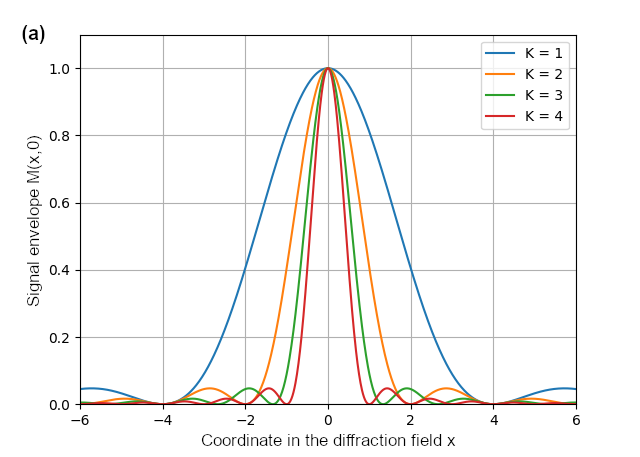
Images reconstructed from holograms have non-negligible
dimensions. For this reason, it is important to consider not
just discrete values, but the envelopes of M(𝑥, 𝑦). Figure 2(a)
shows the distribution M(𝑥, 0) in the horizontal direction
(analysis of the vertical direction would be analogous). Not
only do certain diffraction orders correspond to zero or
near-zero intensities, but the areas around them are visibly
suppressed as well.
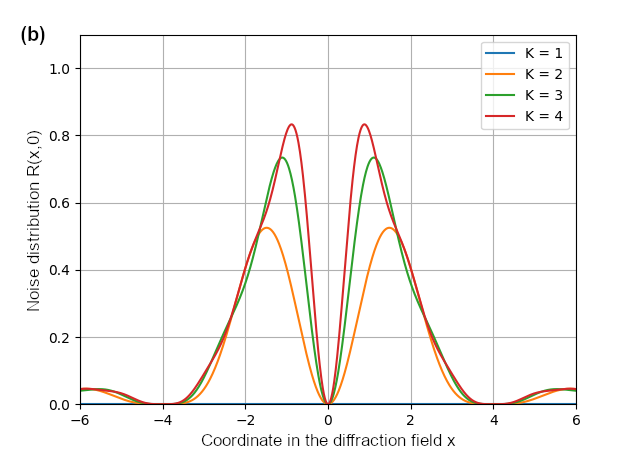
The noise distribution in the horizontal direction can be
calculated from R(𝑥, 0), as presented in Fig. 2(b). In the
centre of the field, the noise is minimal, reaching its maximal
value between the centre of the field and the second order of
diffraction, closer to the centre for higher values of 𝐾. Randomisation
of pixel positions leads to increased noise within the areas of higher diffraction orders, and as such, lowers the
visibility of duplicated images, already suppressed by the
altered M(𝑥, 𝑦) envelope. It is expected that for a properly
chosen randomisation level, those undesired duplicates will
be concealed by the noise, while the central image will
remain relatively undistorted.
Fig. 2. Theoretical distributions calculated for periodic and randomised
pixel patterns as a function of diffraction orders.
(a) Signal envelopesM(𝑥, 0); (b) noise distributions R(𝑥, 0)
in which the blue line overlaps with the horizontal axis.
This randomisation effect, despite the increased noise
levels, can be highly beneficial for certain applications, such
as dynamic holographic projection, in which additional
moving images would be unacceptable to viewers, while
the limited, static noise would be less disruptive. Another
example of a field where the presented image suppression
would be favourable is laser-beam manufacturing or ablation,
in which the interaction between light and the material occurs
above a certain threshold. In such a case, low-intensity noise
will not affect the process, whereas a pattern replica of high
intensity would.
Signal-to-noise ratio (𝑆𝑁𝑅𝑡ℎ) of the whole intensity distribution
can be defined as the ratio of intensity integrals of
the reconstructed signal 𝐼1 (𝑥, 𝑦) and the background noise
𝐼2 (𝑥, 𝑦):
\(
S N R_{t h}=\frac{\iint I_1(x, y) d S}{\iint I_2(x, y) d S}
\) (15)
For a subsection of 4 × 4 pixels, theoretical 𝑆𝑁𝑅𝑡ℎ values
of: 13
for 𝐾 = 2, 18
for 𝐾 = 3, and 1
15 for 𝐾 = 4 are obtained.
The values show that the fraction of incident intensity that
forms the images decreases rapidly with increasing levels of
randomisation. This means that the randomisation method
might have limitations in certain applications, and different
levels of randomisation might be appropriate for images
displayed in the centre of the field and for those spanning
the whole area of a single image reconstruction.
To test the proposed method on a specific case of hologram
reconstruction, the phase hologram of a chequered pattern
(containing 16 black and white squares) was calculated using
the IFTA algorithm [26, 27] on a 512 × 512 px calculation
array. This phase distribution was then oversampled in such
a way that a single phase-shift value corresponded to a whole
4×4 subsection of the 2048×2048 array, and only one pixel
within this subsection displayed phase information. The
oversampled holograms were reconstructed using the fast
Fourier transform. From the resulting complex distribution,
intensity was calculated as the square value of the complex
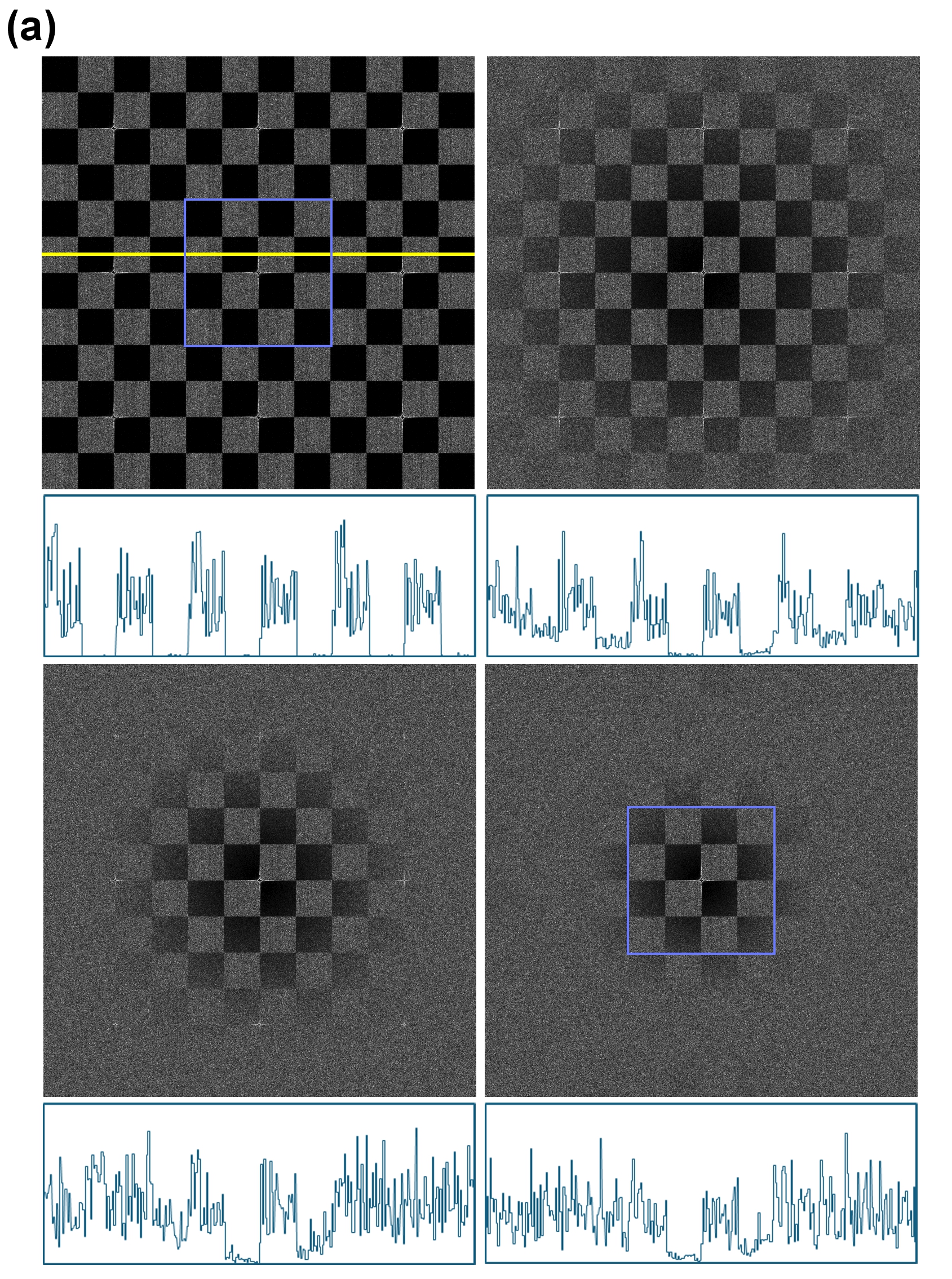
amplitude. The obtained image reconstructions (Fig. 3) show
the suppression of image duplicates in higher diffraction
orders for higher randomisation levels, as predicted by the
presented theoretical analysis. The increase in background
noise is also visible. A sufficiently high randomisation level
can lead to suppression of image duplicates even in the area
of the second diffraction order, by adjusting both the signal
envelope and the noise outweighing the undesired signal.
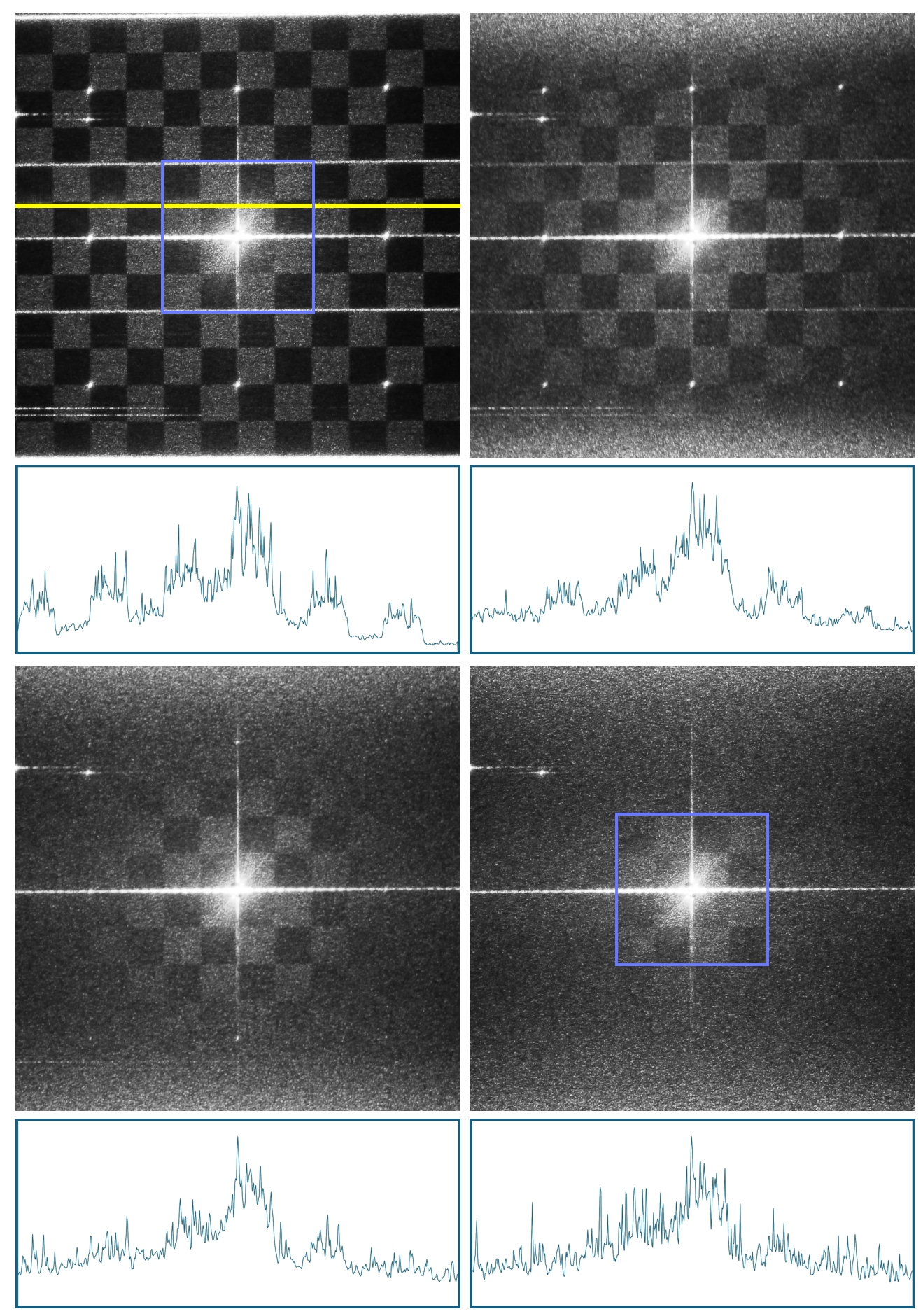
Fig. 3.(a) Simulated image reconstructions: normalised intensity
distributions (here with gamma = 1.5 for readability in
print) with their horizontal cross-sections along the marked
yellow line. Area of a single target image is marked with
a blue square. From left to right and top to bottom: no
pixel randomisation, low, medium, high randomisation level.
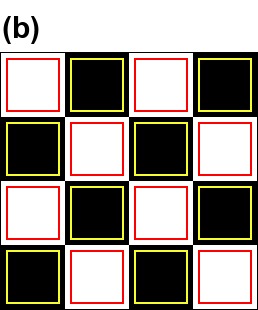
(b) Areas of the chequered pattern, bright (marked in red)
and dark (marked in yellow), used for SNR calculations.
\(
S N R=\frac{\iint I_{\text {bright }}(x, y) d S-\iint I_{\text {dark }}(x, y) d S}{\iint I_{\text {dark }}(x, y) d S}
\) (16)
For this approach, the SNR will assume values above 0 when
the image intensity is higher than the noise.
Calculations were carried out for the whole image (all 16
squares) and the centre of the image area (central 4 squares)
to consider the applicability of the solution for images of both
large and small angular size. The eight nearest duplicates
surrounding the main desired image, all visible in Fig. 3(a),
are considered neighbouring images, for which an averaged
value of SNR was calculated for a more straightforward
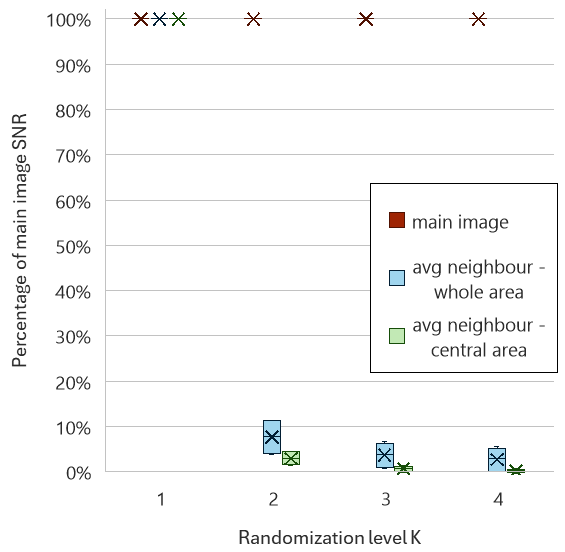
comparison. Fig. 4 (a box plot showing distribution of
data into quartiles, with mean value marked with an x) shows
comparison of SNR values within the main image and its
neighbouring image duplicates. The visibility of undesired
images in comparison to the central area of the image is
successfully reduced.
Fig. 4.Simulation results. Box plot: comparison of the SNR
within the main image and the averaged neighbouring image
duplicates for all randomisation levels, as a percentage of
main image SNR.
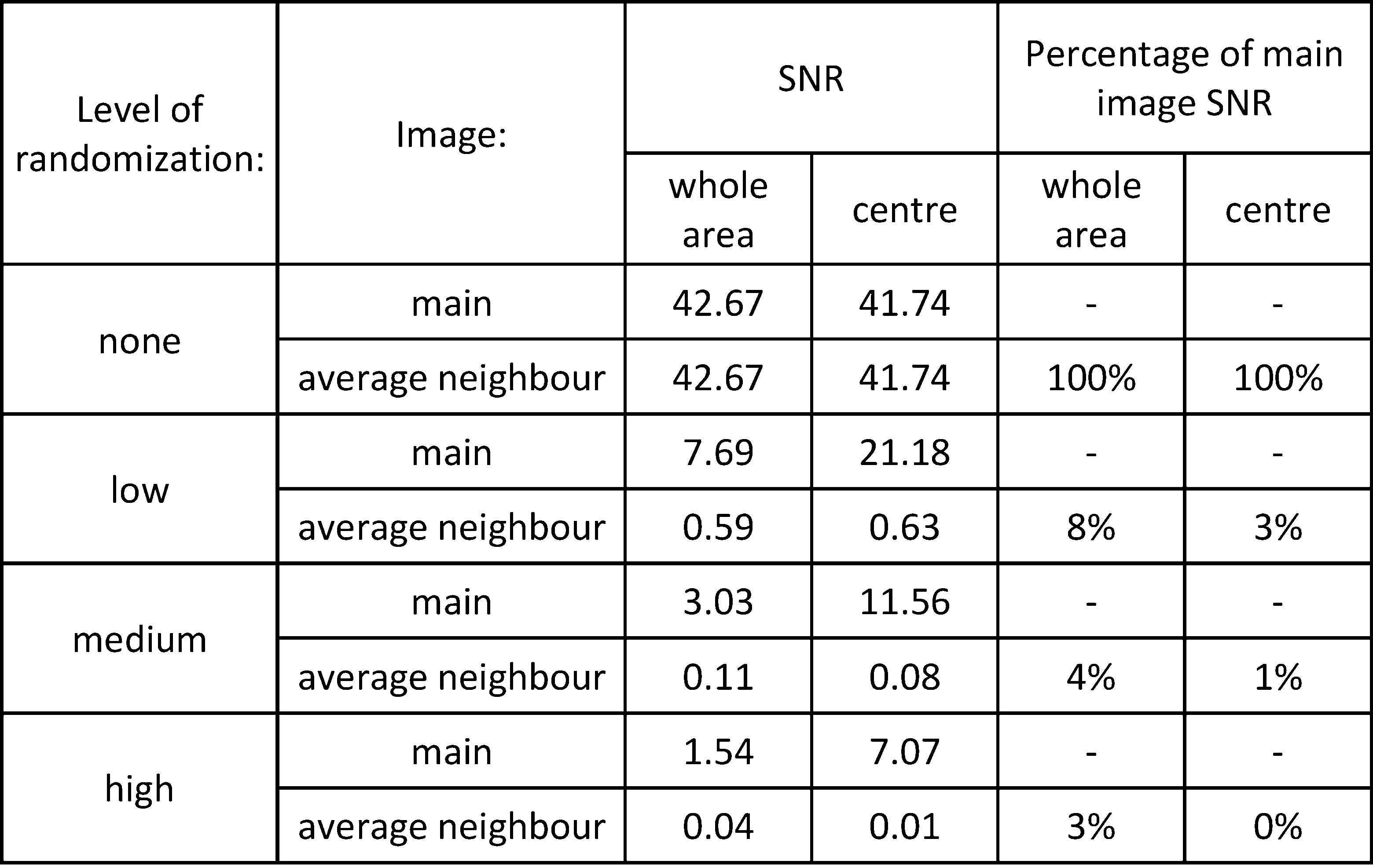
Table 1 presents the values of 𝑆𝑁𝑅 for various levels of
randomisation for further numerical analysis. In line with
theoretical expectations, the SNR declines for all images
when randomisation introduces noise to the hologram reconstruction.
However, it is worth noting that the SNR for
the main image decreases slower than for the image duplicates.
The initial SNR value of 42.67 in the main image
area for no randomisation drops to 7% of its value (to 3.03)
when medium randomisation is applied, while the value of
42.67 for the neighbouring images drops to a much lower
0.11 (less than 1%). For the high randomisation level, the
neighbouring duplicates are similarly indistinguishable from
the background noise, with an SNR equal to 0.04, while
the main image is still visible (SNR of 1.54). For images
spanning the whole area of a single diffraction order, this
strongest randomisation effect might, in some applications,
cause too much noise presence. However, if the analysis
is focused on the central area, where the presumably most
relevant information is displayed and where the images of
a smaller size are typically positioned, the advantage of the
proposed method is even more visible. For example, for
low randomisation level, the central SNR in the main image
decreases only by half, while in the neighbouring areas, the
central SNR drops by 98% (to 0.63). This means that for
images of smaller angular size, pixel randomisation is even
more beneficial, as could be seen in previously published
limited premilinary results [17].
Simulation results for SNR of the main image and the averaged
neighbouring image duplicates for all randomisation levels, with
percentage comparison to the SNR for no randomisation.
Percentage rounded to integers.
Experimental validation
The holograms used in the simulations were then prepared
for experimental validation. In theoretical analysis, it was
possible to assume that pixels not carrying phase information
are not transparent and do not contribute to the resultant
intensity distribution. However, in the case of a real LCoS
SLM, those inactive pixels not only cannot produce 0 values
of amplitude and will instead act as a mirror for the incident
light, but also might carry a phase value influenced by the
neighbouring active pixels. This leads to the presence of
a central bright spot in the image reconstruction. To reduce
its intensity and improve the diffraction efficiency of the
SLM device, a half-wave plate was used in our setup to
adjust the polarisation of the incident beam. The central
noise can be further suppressed with additional methods. In
our experiment, phase values of those inactive pixels were set
as 0 and 𝜋, alternately, in a method researched by Shimobaba
et al. [28]. Two resulting wavefronts modulated by these
two values, respectively, should interfere destructively and
reduce the influence of undiffracted light on the hologram
reconstruction. However, the experiment shows the presence
of other potential distortions of the image.
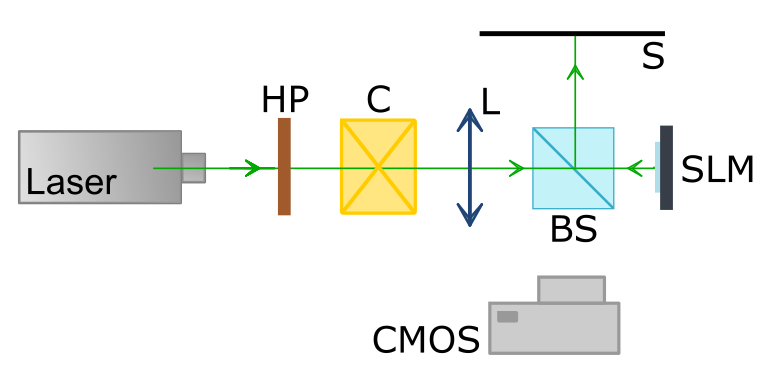
An experimental setup was built as described in the
schematic in Fig. 5. Since the intensity distribution at the
focal length of the lens corresponds to the intensity obtained
through a Fourier transform of a wavefront [19], the presented
setup leads to a reconstruction of a Fourier hologram
on the screen placed at the focal length of the lens. The modulator
used was HOLOEYE PLUTO of 8.0 𝜇m pixel size,
93% fill factor, and FHD resolution. It was illuminated with
a laser beam of wavelength 𝜆 = 532 nm. The beam splitter
was placed 16 cm from the focusing lens and 4 cm from the
SLM, and the distance from the beam splitter to the screen
was 140 cm. The reconstruction of the holograms displayed
on the SLM was observed on a screen and photographed
using a CMOS camera. Images for various levels of randomisation
are presented in Fig. 6. The visible noise aligns with theoretical assumptions, though it is more pronounced than
in simulations because of imperfections of the experimental
setup, such as distortions of the displayed phase caused by
pixel crosstalk. However, creating the optimal hologram
reconstruction setup was not the goal of this research and
the obtained results are more than sufficient to observe the
discussed phenomenon.
Fig. 5.Schematic of a setup for hologram reconstruction. Laser
source of 𝜆 = 532 nm, SLM – LCoS SLM HOLOEYE
PLUTO, HP – half-wave plate, C – collimator, L – lens
focusing the wavefront on S – screen, BS – beam splitter,
CMOS - camera.
Fig. 6.Image reconstruction from randomised holograms on an
undersampled SLM with their normalised horizontal crosssections
along the marked yellow line. Area of a single
target image is marked with a blue square. From left to right
and top to bottom: no pixel randomisation, low, medium,
and high randomisation level.
To confirmthe qualitative results, a numerical analysiswas
also performed. SNR was calculated according to (16) for images
obtained for all randomisation levels. The calculations
were carried out only for the full image area (16 black-andwhite
squares) this time, as the high central noise in the
experiment would strongly impact the results for a smaller,
limited area which was considered in simulation results. As
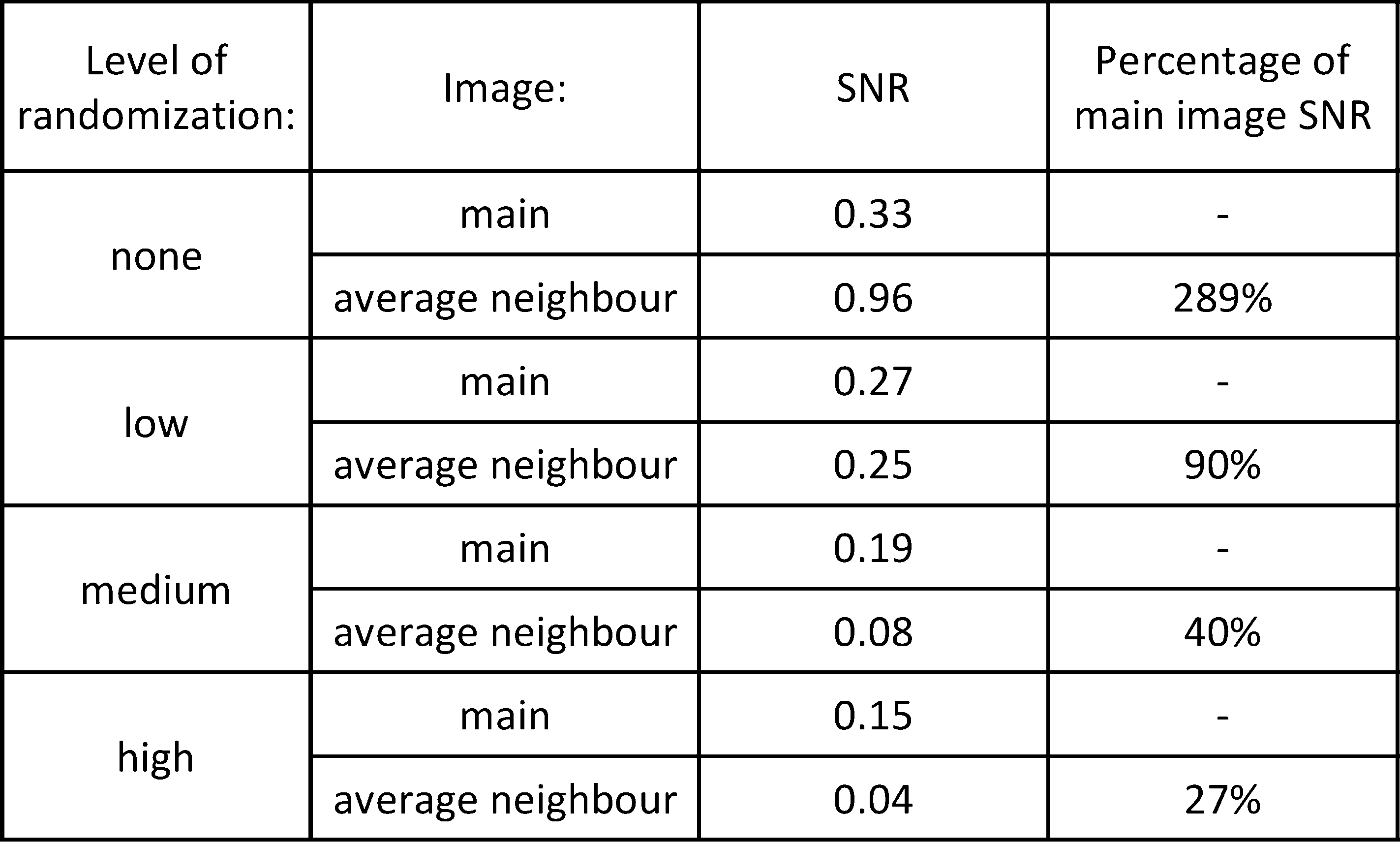
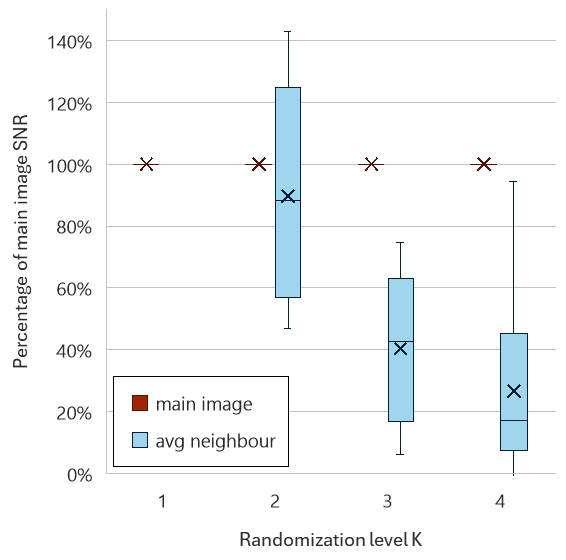
presented in Fig. 7 and Table 2, the SNR of neighbouring
image duplicates decreases with increasing randomisation
levels, confirming the effect predicted by theoretical analysis
and simulations. For the highest level of randomization, the
SNR value decreases by 55% within the main image and by
96% in the surrounding image duplicates. This difference
leads to the lack of distinguishable replicas in hologram
reconstruction. Although the effect seems weaker than in
the simulations, this can be linked to strong presence of the
undiffracted light in the experiment, which lowers the initial
SNR of the main image: with no randomisation applied, the
SNR of the neighbouring images was almost three times
higher than the SNR within the target image (0.96 compared
to 0.33). After applying the highest randomisation, the SNR
of image duplicates reaches a value as low as 27% of the
main image SNR, which is a relevant improvement.
Experimental results for SNR of the main image and the averaged
neighbouring image duplicates for all randomisation levels, with
percentage comparison to the SNR for no randomisation.
Percentage rounded to integers.
Fig. 7.Experimental results. Box plot: comparison of the SNR
within the main image and the averaged neighbouring image
duplicates for all randomisation levels, as a percentage of
main image SNR. Neighbouring images for the case of no
randomisation far exceed the SNR of the main image, and
are not visible in the chart.
Conclusions
The presented method is successful in reducing the visibility
of duplicate images in a holographic reconstruction of dynamic
Fourier holograms. We achieved the visual limitation
of distinguishable images to the centre of the display field
and carried out the numerical analysis of obtained simulation
and experimental data that confirm the subjective visual evaluation
of this effect. While noise increases and the SNR of
all images is lower compared to the case of no randomisation,
the ratio of SNR between the neighboring duplicates and the
main desired image decreases. The numerical analysis (see Table 1) shows that for the highest level of randomisation
considered, this ratio is as low as 3%. This solution can be
applied in a holographic projection, e.g., in efficient, miniaturised
projectors or head-up displays, which demand low
volume of a setup and in which noise distribution that does
not shift depending on the displayed image is a lesser disruption
than multiple replicas of the desired image. It could also
be beneficial for applications with threshold effects, e.g., in
laser-beam fabrication, where low-intensity noise does not
impact the outcome. Importantly, the level of randomisation
can be chosen based on a particular application and target
size of the reconstructed pattern. Further research into the
optimal size of the SLM subsection is needed, as only 4 × 4
areas have been analysed so far.
Authors’ statement
Research concept and design, J.S. and A.K.; collection and/or
assembly of data, J.S., J.B., K.K. and K.P.; data analysis and
interpretation, J.S., J.B. and K.K.; writing the article, J.S.;
critical revision of the article, K.P. and A.K.; final approval
of article, J.S. and A.K.
Acknowledgements
This research was funded by the National Science Centre,
Poland under the Preludium program (021/41/N/ST7/01520),
and by the National Center for Research and Development,
Poland under the LIDER program (LIDER/15/0061/L-
9/17/NCBR/2018).
Nehmetallah, G. & Banerjee, P. P. Applications of digital and analog holography in three-dimensional imaging. Adv. Opt. Photonics 4, 472–553 (2012). https://doi.org/10.1364/AOP.4.000472.
Haleem, A., Javaid, M. & Khan, I. H. Holography applications toward medical field: An overview. Indian J. Radiol. Imaging 30, 354–361 (2020). https://doi.org/10.4103/ijri.IJRI_39_20.
Zhang, Y., Lu, Q., Ge, B., Zhao, H. & Sun, Y. Digital holography and its application. Proc. SPIE 5636, Holography, Diffractive Optics, and Applications II (2005). https://doi.org/10.1117/12.570295.
Slinger, C. et al. Recent developments in computer-generated holography: Toward a practical electroholography system for interactive 3d visualisation. Proc. SPIE 5290, 27–41 (2004). https://doi.org/10.1117/12.526690.
Slinger, C., Cameron, C. & Stanley, M. Computer-generated holography as a generic display technology. Computer 38, 46–53 (2005). https://doi.org/10.1109/MC.2005.260.
Poon, T.-C. (ed.) Digital Holography and Three-Dimensional Display: Principles and Applications (Springer, 2006).
Yamaguchi, T. Real-time image plane full-color and
Wei, L. et al. Diffraction properties of quasi-random pinhole arrays: Suppression of higher orders and background fluctuations. J. Mod. Opt. 64, 2420–2427 (2017). https://doi.org/10.1080/09500340.2017.1367853.
Agour, M., Falldorf, C. & Von Kopylow, C. Digital
pre-filtering approach to improve optically reconstructed wavefields in opto-electronic holography. J. Opt. 12, 055401 (2010). https://doi,org/10.1088/2040-8978/12/5/055401.
Agour, M., Falldorf, C. & von Kopylow, C. Complementary filtering approach to enhance the optical reconstruction of holograms from a spatial light modulator. In Osten, W. & Kujawinska, M. (eds.) Fringe 2009, 1–6 (Springer, 2009). https://doi.org/10.1007/978-3-642-03051-2_34.
Gopakumar, M., Kim, J., Choi, S., Peng, Y. & Wetzstein, G. Unfiltered holography: Optimizing high diffraction orders without optical filtering for compact holographic displays. Opt. Lett. 46, 5822–5825 (2021).https://doi.org/10.1364/OL.442851.
Park, J., Lee, K. & Park, Y. Ultrathin wide-angle large-area digital 3d holographic display using a non-periodic photon sieve. Nat. Commun. 10, 1304 (2019). https://doi.org/10.1038/s41467-019-09126-9.
Agour, M., Kolenovic, E., Falldorf, C. & von Kopylow, C. Suppression of higher diffraction orders and intensity improvement of optically reconstructed holograms from a spatial light modulator. J. Opt. A: Pure Appl. Opt. 11, 105405 (2009). https://doi.org/10.1088/1464-4258/11/10/105405.
Smalley, D. E., Smithwick, Q. Y. J., Bove, V. M., Barabas, J. & Jolly, S. Anisotropic leaky-mode modulator for holographic video displays. Nature 498, 313–317 (2013). https://doi.org/10.1038/nature12217.
Starobrat, J. et al. Photo-magnetic recording of randomized holographic diffraction patterns in a transparent medium. Opt. Lett. 45, 5177–5180 (2020). https://doi.org/10.1364/OL.400857.
Stupakiewicz, A., Szerenos, K., Afanasiev, D., Kirilyuk, A. & Kimel, A. V. Ultrafast nonthermal photo-magnetic recording in a transparent medium. Nature 542, 71–74 (2017). https://doi.org/10.1038/nature20807.
Goodman, J. W. Introduction to Fourier Optics (Roberts and Company Publishers, 2005).
Gao, S., Sánchez-López, M. D. M. & Moreno, I. Feasibility study of liquid-crystal spatial light modulators for displaying triplicator gratings at their spatial resolution limit. Proc. SPIE 13016, 13160O (2024).https://doi.org/10.1117/12.3017454.
Zang, H. P. et al. Elimination of higher-order diffraction using zigzag transmission grating in soft x-ray region. Appl. Phys. Lett. 100, 111904 (2012). https://doi.org/10.1063/1.3693395.
Gao, N. & Xie, C. High-order diffraction suppression using modulated groove position gratings. Opt. Lett. 36, 4251–4253 (2011). https://doi.org/10.1364/OL.36.004251.
Liu, Z. et al. Two-dimensional gratings of hexagonal holes for high order diffraction suppression. Opt. Express 25, 1339–1349 (2017). https://doi.org/10.1364/OE.25.001339.
Li, H., Shi, L., Wei, L., Xie, C. & Cao, L. Higher-order diffraction suppression of free-standing quasiperiodic nanohole arrays in the x-ray region. Appl. Phys. Lett. 110, 041104 (2017). https://doi.org/10.1063/1.4974940.
Kim, H., Yang, B. & Lee, B. Iterative Fourier transform algorithm with regularization for the optimal design of diffractive optical elements. J. Opt. Soc. Am. A 21, 2353–2365 (2004). https://doi.org/10.1364/JOSAA.21.002353.
Shimobaba, T. et al. Simple complex amplitude encoding of a phase-only hologram using binarized amplitude. J. Opt. 22, 045703 (2020). https://doi.org/10.1088/2040-8986/ab7b02.