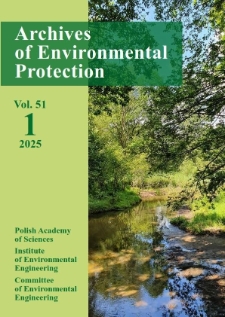
Website update
This page is the archival website of Archives of Enviromental Protection in the journals.pan.pl service. It is no longer updated and remains available as an archive of previously published volumes and articles.
The current official website of the journal, including latest issues, submission information, editorial policies, author guidelines, and contact details, is available here:
https://wydawnictwo.pan.pl/index.php/aep
The website address has been changed as part of the modernization of the publishing platform of the Polish Academy of Sciences, aimed at improving the clarity, accessibility, and consistency of journal information.
Archives of Environmental Protection is the oldest Polish scientific journal of international scope that publishes articles on engineering and environmental protection. The quarterly has been published by the Institute of Environmental Engineering, Polish Academy of Sciences since 1975. The journal has served as a forum for the exchange of views and ideas among scientists. It has become part of scientific life in Poland and abroad. The quarterly publishes the results of research and scientific inquiries by best specialists hereby becoming an important pillar of science. The journal facilitates better understanding of environmental risks to humans and ecosystems and it also shows the methods for their analysis as well as trends in the search of effective solutions to minimize these risks.
Copyright on any open access article in the Archives of Environmental Protection journal published by Polish Academy of Sciences is retained by the author(s). Authors grant Polish Academy of Sciences a license to publish the article and identify itself as the original publisher. Authors also grant any user the right to use the article freely if its integrity is maintained and its original authors, citation details and publisher are identified. The Creative Commons Attribution-ShareAlike 4.0 International Public License (CC BY-SA 4.0) formalizes these and other terms and conditions of publishing articles.
The editorial team of Archives of Environmental Protection implements an open access policy by publishing materials in the form of the so-called Gold Open Access and encourages authors to place articles published in the journal in open repositories (after the review or the final version of the publisher), provided that a link to the journal’s website is provided.
For the articles which were previously published, before year 2021, policies that are different from the above. In all such, access to these articles is free from fees or any other access restrictions. Permissions for the use of the texts published in that journal may be sought directly from the Editors, by e-mail: aep@ipispan.edu.pl.
The journal is indexed by Clarivate Analytics services (Biological Abstract, BIOSIS Previews) and has an Impact Factor (June 2025) of 1.8
CiteScore 2025: 2.7
SCImago Journal Rank (SJR) 2025: 0.39
Source Normalized Impact per Paper (SNIP) 2025: 0.56
We accept article submissions exclusively through the new OJS system:
Submit your article
 0000-0003-2698-54370000-0001-9534-74260000-0002-1805-2189 0000-0002-4339-06570000-0001-6866-74320000-0002-1242-33640000-0002-1242-33640000-0002-7328-461X0000-0002-3921-74720000-0002-7697-2514 0000-0003-2954-83470000-0001-6122-31690000-0002-8188-042X0000-0001-8777-49890000-0003-4441-74090000-0003-1909-285X0000-0003-1925-680X0000-0002-2340-80200000-0002-1864-11430000-0001-6660-99920000-0001-7435-56460000-0002-3572-60500000-0001-9778-42830000-0002-8892-51170000-0002-7980-41370000-0002-5155-05930000-0002-5859-73350000-0002-3978-24200000-0003-3779-4177

In environmental matrices there are mixtures of parent drug and its metabolites. The majority of research is focused on the biological activity and toxic effect of diclofenac (DCF), there is little research on the biological activity of DCF metabolites and their mixtures. The study focused on the assessment of the biological impact of DCF, its metabolites 4’-hydroxydiclofenac (4’-OHDCF) and 5-hydroxydiclofenac (5-OHDCF) and their mixtures on E. coli strains. The biological effects of tested chemicals were evaluated using the following: E. coli K-12 cells viability assay, the inhibition of bacteria culture growth, ROS (reactive oxygene species) generation and glutathione (GSH) content estimation. Moreover, we examined the influence of the mixture of DCF with caffeic acid (CA) on E. coli cells viability. Our results showed the strongest impact of the mixtures of DCF with 4’-OHDCF and 5-OHDCF on E. coli SM biosensor strains in comparison to parent chemicals. Similar results were obtained in viability test, where we noticed the highest reduction in E. coli cell viability after bacteria incubation with the mixtures of DCF with 4’-OHDCF and 5-OHDCF. Similarly, these mixtures strongly inhibited the growth of E. coli culture. We also found synergistic effect of caffeic acid in combination with DCF on E. coli cells viability. After bacteria treatment with the mixture of DCF and its metabolites we also noted the strongest amount of ROS generation and GSH depletion in E. coli culture. It suggests that oxidative stress is the most important mechanism underlying the activity of DCF and its metabolites.
This study aimed to determine the influence of the electric current density on the rate of nitrogen compounds removal (rN) and the specific rate of denitrification (rD) in a rotating electrochemical disk contractor (RECDC) and a rotating electro-biological disk contactor (REBDC). In REBDC and RECDC, the cathode consisted of disks with immobilized biomass and disk, from which biofilm was periodically removed, respectively. An aluminum anode was mounted in contactor chambers. The study was conducted using synthetic wastewater with characteristics similar to wastewater from soilless cultivation of tomatoes. The first stage of the study determined rN and rD in the RECDC. The second stage determined rN and rD in the REBDC. Four hydraulic retention times (HRT) were tested: 4 h, 8 h, 12 h, and 24 h, with electric current densities of 0.63 A/m2, 1.25 A/m2, 2.50 A/m2, 5.00 A/m2, and 10.00 A/m2. In RECDC, a linear dependency was observed between rN and current density in the examined HRTs, whereas in REBDC, a logarithmic dependency was confirmed between rN and current density. In both contactors, an exponential dependency was observed between rD and current density. The specific rate of denitrification decreased when the current density and HRT were increased. The study showed that, in both contactors, the rate of total nitrogen removal increased when the current density was increased and the HRT was decreased.
Operations conducted by petroleum industry generate an entire range of drilling waste. The chemical composition of drilling waste and its toxicity depend primarily on the geological and technological conditions of drilling, the type of drilled rock deposits and on the type and composition of the drilling mud used. In the course of drilling operations, drilling fluids are in constant contact with bacteria, fungi and other organisms infecting the mud. Pioneer species, capable of surviving and using the resources of this specific environment, are selected. For this reason, the effectiveness of microbiota survival on different types of spent drilling muds and in different dilutions with brown soil was measured. Spent drilling muds samples came from drilling operations in various regions of Poland, e.g. Subcarpathia, the Polish Lowland and Pomerania regions. Oxygen consumption after 96 h was around 20 μg·g‒1 dry mass in soil or soil/drilling water-based mud mixture. Soil mixes contained 10 wt% synthetic base, mud had a higher oxygen consumption – 38 μg · g‒1 dry mass. Oxygen consumption decreases sharply as the content of the spent synthetic base mud fraction increases. A higher concentration of spent SBM (35 wt%) reduced the aerobic metabolism by slightly more than 50%. A high concentration of reduced carbon decreased the respiratory quotient (RQ) value to 0.7. All the researched drilling waste shows microbiological activity. At the full concentration of drilling fluids and non-dilution options, the chemical composition (salinity, inhibitors, etc.) strongly inhibits microbiota development and consequently, respiration
The article presents the research into hygienizing process of chicken manure using calcium peroxide (CaO2) as an environmentally friendly biological deactivation agent. The influence of the addition of CaO2 to chicken manure on the bioavailability of phosphorus was also analyzed. The process of biological deactivation using CaO2, CaO and Ca(OH)2 agents was analyzed applying the disk diffusion method. To optimize the effect of the hygienizing parameters, (CaO2 concentration, pH, temperature and time) on the reduction of Enterobacteriaceae count the Taguchi method was applied. The content of bioavailable phosphorus was measured with the Egner-Riehm method and determined with spectrophotometry. The reduction in bacterial count followed an increase in the concentration of CaO2 in a sample. The optimal experimental conditions (CaO2=10.5 wt.%, pH=9.5, T=40°C, t=180 h) enabled a significant decrease in the Enterobacteriaceae count, from 107 cfu/g to 102 cfu/g. Analysis of the samples with Egner-Riehm method showed that the phosphorus content decreased with the addition of biocide CaO2: from 26.6 mg/l (for 3.5 wt.%) to 3.5 mg/l (for 10.5 wt.%). These values were slightly higher than the content of phosphorus deactivated with Ca(OH)2 i.e., from 11.25 mg/l (for 3.5 wt.%) to 4.49 mg/l (for 10.5 wt.%). The application of CaO2 for hygienizing chicken manure enables effective reduction of Enterobacteriaceae count to an acceptable level (below 1000 cfu/g). In comparison with the traditional techniques of hygienization, the application of CaO2 has a positive effect on the recovery of bioavailable phosphorus.
In water systems, both biologically and chemically synthesized molecules may reduce environmental quality and influence essential ecosystems structure and function. These substances include aldehydes from various sources, also those relates to the activities of primary producers. The focus of the study was vertical distribution of several aliphatic aldehydes and phytoplankton biomass in an urban lake in Poznań (Wielkopolska Lakeland, Poland) under human pressure. Water samples were collected from surface lake to bottom, every 2 m. Plankton was analyzed under inverted and epifluorescence microscopes. The biomass was estimated from microscopic measurements and cell volume of each species. Thirteen aldehydes and acetone were analyzed using gas chromatography with an electron capture detector after derivatization and extraction processes. Aldehydes concentrations varied between 32.7 and 346.2 μg L-1. Formaldehyde, acetaldehyde and propanal were characterized by the highest concentration both at low and high phytoplankton biomass. Phytoplankton biomass included prokaryotic and eukaryotic cells, and ranged between 0.25 and 2.94 mg L-1. Cryptophytes and diatoms were often the most important components of phytoplankton communities, although in some cases the haptophytes and dinophytes comprised a much higher proportion. Total aldehyde concentration was significantly correlated with total phytoplankton biomass (r=0.705, p <0.05), and even higher correlation was observed between acetone and phytoplankton biomass (r=0.917). This indicates phytoplankton as an important source of carbonyl compounds in surface waters. Thus, the knowledge of different aspects of their origin and distribution in the lake is important both in ecological research and in water management.
The aim of this study was an assessment of feasibility of conversion of sewage holding (SH) tanks to rainwater harvesting (RWH) tanks in Poland. Such a conversion may partly solve the problem of water scarcity for irrigation of plants in individual small gardens and reduce tap water consumption. Seven methods of RWH tanks sizing were applied to an example of a small harvesting system of the roof area equal to the garden irrigation area of 100 m2 for three different irrigation doses. A new criterion was introduced to optimize the tank capacity. Economic optimization was provided for new RWH tanks and for the tanks adapted from abandoned SH tanks. Results obtained for a system sited in west-central Poland in an average year have shown that design capacity of RWH tanks varied markedly between sizing methods. The conversion of SH tanks to RWH tanks is profitable, especially for irrigation due to scarcity of water in relatively dry west-central regions. Conversion of individual SH tanks in a good technical state to RWH tanks is relatively simple and cheap. The potential increase in storage volume due to the conversion of individual SH tanks to RWH tanks could reach all over Poland 215–350 dam3 per year, and individually can save up to 18–25% of total annual water use.

 en
en
 pl
pl